
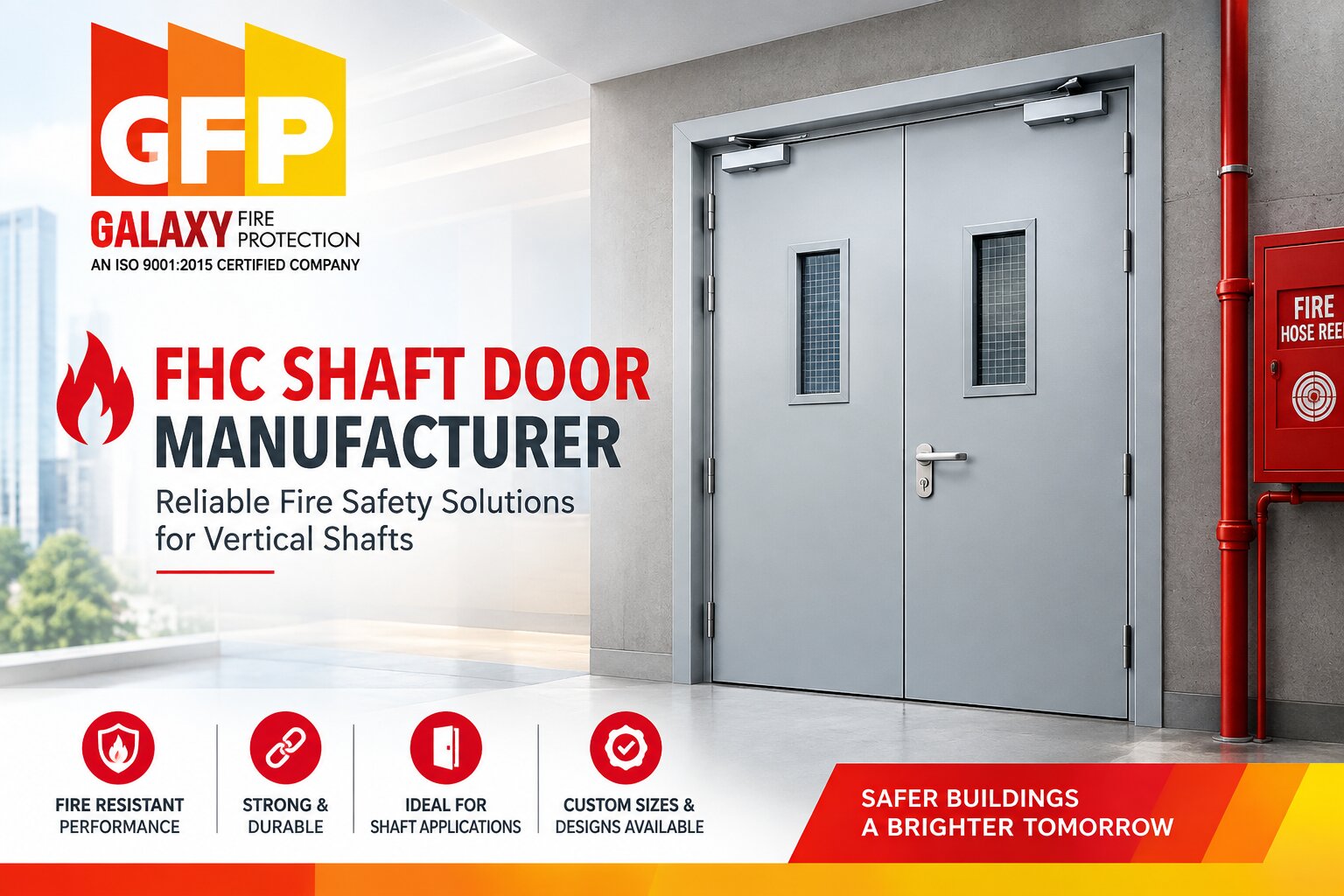
Buyers often get confused when buying a shaft door due to the terms like ‘fire-tested shaft door’ and ‘fire-rated shaft door’. Both of them sound similar to anyone who is not aware of the differences in their performance and testing. As a leading FHC shaft door manufacturer, we are here to help buyers get over this confusion by sharing differences in between the two. It will help buyers make the right decision when looking for a FHC shaft door for any commercial, industrial, or residential project.
As the name suggests a fire-tested door has gone through specific fire tests to determine how it performs under fire conditions. Whereas a fire-rated shaft door is given a specific rating according to how long it can resist fire or the required fire-testing standards. But that’s not the only difference, there are many more which we will discover through this blog.
Difference in Their Classification
A fire-tested shaft door physically goes through a fire testing along with other assembled parts including frame, hardware, and hinges. It is tested under real fire conditions to ensure that it meets all the required BIS standards that are a must to make it perform well during fire accidents. On the other hand, a fire-rated door is classified according to the fire-resistance compliances. The respective standards are decided either by directly testing it or by understanding the compliances or manufacturing standards followed during its fabrication.
Difference in Fire Duration
When speaking about the fire-tested shaft doors, the duration or rating given to them comes from how they performed during the test. This means for how long they survived the real fire testing scenario. It is then being rated for 60 minutes, 90 minutes, or 120 minutes. Whereas, for fire-rated shaft doors, the time or rating is applicable according to the standard they are classified for. It is stated in the document provided by the FHC shaft door manufacturer, who ensures that the door meets the expected requirement. Though, this duration standard is decided either by considering the door test or the manufacturing standards followed during its construction.
Difference in Proof of Fire-Resistance
Every fire-tested door goes through real lab based fire-testing. Then only it is decided which fire-resistance rating they fit into. These doors come with a real report showing that door has been tested and has passed the fire-testing requirements. But when it comes to fire-rated doors, there is no direct proof. Their rating is often based on the applicable compliances or standards rather than real fire-testing.
Difference in Compliance Documentation
As we stated above, fire-tested shaft doors go through real tests and that is why buyers will get official test certificates with these doors. These certificates show that the fire door you are buying has passed all these fire tests and is capable of resisting fire up to certain duration which is the rating mentioned on it. However, the fire-rated shaft doors only come with a compliance certificate and they do not state that the door has passed a certain lab test. The compliances say that the door follows the right codes and based on that they have been provided with certain rating or standard.
Difference in Their Inspection
Fire-tested doors easily pass the inspections as they are given the rating only when they have passed the lab fire testing. Though inspectors may still test them to verify the authenticity of a given test-certificate. On the other-hand fire-rated shaft doors which are code-compliant and legally acceptable, may not easily pass through inspection. Manufacturers may have to answer more questions regarding these doors as they are not backed by a direct test report.
Conclusion
For commercial buildings or high-rise buildings, shaft doors are crucial as they are known for containing fire and smoke. But when buying them, buyers must pay close attention to whether they should go for fire-tested doors or fire-rated doors. We recommend buyers to ask FHC shaft door manufacturer to provide information about testing standard, fire-resistance period, tested configuration, frame, hardware, seals, dimensions, installation requirements and supporting documentation. We at Galaxy Fire Protection Co. manufacture reliable shaft doors for applications where fire protection and controlled access are required. We are there to assist buyers in understanding the relevant product specifications and select a suitable shaft door for their requirements.
FAQs – Frequently Asked Questions
Not necessarily; the term “fire-tested” by itself does not tell you the complete fire-resistance classification of the product. The applicable test results and classification should be verified.
A stated fire-resistance rating should be supported by the applicable testing and classification requirements. Buyers should ask for the relevant supporting documentation.
Check the testing standard, tested dimensions, door construction, frame, hardware, seals, installation arrangement, test duration, and performance criteria covered by the report.
A fire test evaluates how a particular assembly performs under defined fire conditions. A fire rating is the resulting recognised classification or performance designation based on applicable requirements.
Yes, reviewing the supporting test information and the stated classification helps establish whether the product meets the project’s specified fire-performance requirement.